To live a self-sufficient and organic lifestyle for the next half century. With the Grace of God and the power of prayer, we will succeed. Nothing is impossible with His help. It wouldn't be us without laughter and joy at the Cockeyed Homestead.
I've tried just about every type of gardening in the past forty years. Back to Eden, Square Foot, Lasagna, and the old, tried and plow it up and plant plus a few more. I even tried out planting in the weeds only to end up failing. They all have one thing in common they build up the soil except the tiller option. It's different strokes for different folks. But it's beside me on getting a decent harvest on this new homestead. It's a constant battle with varmints and weeds.
I watched an interesting documentary on Netflix this week entitled, "Kiss the Ground." I found it interesting because it reinforced my beliefs in the way I've gardened all my life. The whole gist of the show was to reduce the carbon footprint of the Earth by building soil not dirt. I've always gardened organically, only tearing up the dirt to add amendments but only the top six inches. As of 8 years ago, I stopped tilling with a cultivator altogether in favor of building up the beds as they stood. I've looked for other ways to combat the weeds. I am selective in my weed control also. Not every weed is a bad weed. My newest choice is the Ruth Stout Method. Although I've been doing a variation of this all along, I'm going to try it just as it was written up by the lady herself.
This spring, I was hopeful and praying that our vegetable garden would produce a good harvest. But the cockeyed weather cycle beat me down. Constant rains, cooler than normal weather, and blistering hot and humid weeks just ruined all my efforts.
We've got some major changes happening on the homestead over the next two to three years. It's something that has been in the plan all these years since I moved up to these northeast GA mountains, but couldn't implement it. But more on that later.
This year was a bad year for vegetables, but a great year for fruits as you can tell from my posts. For the past two weeks it's all been about apples. Applesauce, apple cider, mincemeat, diced and sliced, pie filling, apple butter, and on and on, ending with pectin and apple cider vinegar. The apple harvest like all my plants were delayed by a month because of the weather. It's actually been a good enough year for fruits that I've put up at least two years worth.
But as yucky as my vegetable harvest was, I was able to shop locally (friends and neighbors) and the wholesale house for vegetables to put by. I actually put up 18 months worth of vegetables. All that is left to can is meats, but I can locally source that too as needed. I put my meager stimulus check to good use in restocking my pantry out building. Did I tell you we found a rat proof insulation...corrugated foil wrap. It set us back almost $200 but it's worth it. The stores building stayed about 60 degrees even on the hottest days of summer.
Back to the topic at hand. With the changes upcoming in fall 2021, I've got spring and summer to make the garden produce even more food stuff. After that I won't have an easily access garden in front of our trailer for at least a year. I'll have to garden in the orchard area. It will be competing with the wheat and oats, and orchard grass that's usually grown down there. Now, there's the new chicken coops and runs as well as the fruit trees. It's getting to be a crowded 1/4 acre. But it's only a short-term situation.
With my eyes on higher production, I read about the Ruth Stout Method of gardening. I was intrigued. Basically, you grow your vegetables in 2'-3' mounds of hay and compost. With our chickens, we've got plenty of compost. Getting that much hay is problematic but doable. We still have enough wood chips from the tree service delivery to make the walkways. I'll still be doing the weed blocker fabric for my tomatoes and peppers. My tomatoes might have died, but it held the weeds down to a manageable chore.
Now that there's a lull in food preservation or at least slowing down a bit, I can split my focus on preparing beds for next year. This experiment will be for my carrots, onions, potatoes, and sweet potatoes. Later on in the season, there'll be other crops planted. I'm thinking green beans, cucumbers, and maybe squashes in the hay rows. It will definitely be easier on my back harvesting them.
If this works, I'll have a jump start in 2023 with a new 50' x 120' homestead/market garden. Yes, I'll mostly be starting from scratch again...sigh!, but at least it will be a regular type garden instead of plant where you can around the landscaping. I'll have to bring in truck loads of wood chips and compost for that first year, but after that, our homestead should produce enough to maintain the new garden. Also in the works is a high tunnel greenhouse (20'x 50') and a small seed starting greenhouse (10'x10') made of repurposed windows and pallet lumber. It'll be this homesteader's dream fulfilled when finished...or at least these homesteaders.
The brooder box Mel built out of scrap lumber now sits behind the sofa. Made from 2x4s and sheeting boards, this thing is heavy! Mel had to dismantle it and carry it in pieces, and put it back together in place. When I asked her why she didn't split the 2x4s on the table saw, she said, "I dunno. I didn't think of it."
Instead of a heat lamp, we're using our heating pad once again. This time it's draped over an arched wire frame work. The chicks can go under it for warmth. We put a layer of pine shaving on the bottom of the box. It's easy enough to clean out with a whisk broom and bucket for the waste...it will all go into the compost pile.
Mel ordered fifteen All Female Rainbow Chick Layers from Meyer's Hatchery last week and the variety assortment arrived on Tuesday. The ad said at least 5 different breeds of chickens and from the looks of the identifying leg tags, we've got 7-10 distinctly different breeds.
From Meyer's catalog
From the picture in the ad, they should be a colorful assortment. We decided not to free range these because some of them are considered rare breeds. We want to protect them. These are strictly egg layers. With so many varying breeds of chickens in one coop/run, it will be interesting to see what kind what kind of personalities and pecking order they establish. Up until now, we've only raised Rhode Island and New Hampshire Reds, and Buff Orpingtons. We'll raise all of them to be friendly to humans. Not necessarily children friendly 'cause we ain't got any rug rats around this homestead. Or, at least not at any given time.
Every day, these chicks are handled by Mel and I. We just can't help it. They are such cute, little puff balls right now. We'll talk to them and cuddle them. We are certainly imprinted in their little minds already. I expect they'll try and follow us all over the place if we let them. I can see it now, all of them squawking to be picked up and loved on every time we enter the chicken run just like Broody and Black Butt does now. Lord knows, the the decibel level of peeps of these chicks dropped once I put them under the heated section of the brooder or we snuggle them inside our flannel shirts.
From Meyer's catalog
I'm personally looking forward to spring and having our own, fresh eggs again. Broody and Black Butt have stopped laying eggs. For Broody, I think it's age. She is in her 4th year. Black Butt stopped laying in the nest box with the Kassity killing Baby Girl. It could be a winter thing too. I may put a nesting tote in the bunny/chicken barn. So we've actually had to start buying eggs from the store for homestead use! I can surely tell the difference between our eggs and store bought ones. The yolks are yellow instead of orange and the whites are runny in comparison. There's a difference in taste and cooking/baking results too. Our homestead eggs were superior. Hopefully these new chicks will start laying by June for abundance of eggs to have and sell. Plus eggs from the other birds.
The quail pens are built and awaiting quail. Next livestock auction, I'll be buying some full grown quail and buying some fertile quail eggs to incubate. So our poultry farm begins. I'll have to revamp this design to add some quail and change it to "poultry farm." I still need to clean up the design some. Or, maybe I'll leave it alone for now.
Well, Mel and I have had enough of recovering the hoop house greenhouse with plastic each year. No matter what we did, the winds whipping through our hollow just destroyed the plastic. No matter how often we patched it. In the summer months, it's too blasted hot in there for anything to survive inside. Even our few tropical plants whimpered for mercy. With the hanging of plastic on the back porch last fall, we have a 16' x 24' area to use for seed starting. It made the greenhouse obsolete.
We had thought of covering the greenhouse with shade cloth during the summer to continue growing tender crops like lettuces, micro greens, and spinach on the benches built inside. We'd even talked about dismantling it and moving it down in the orchard.As part of our heat the greenhouse in winter, we usually house a couple rabbits in there and practice deep bedding methods. So there's a few months worth in there already composting away. When mixed with peat moss in late winter becomes our seed starting mix for spring planting. This year, we are rethinking the whole kit and kabootle. Did I just age myself with that phrase? Ah, heck, y'all know I'm an elderly, albeit feisty, old broad anyhow, don't you?
We are tearing off the plastic for good off the old hoop house greenhouse. We are building a 3 1/2' wide grow bed on each of the long sides of the structure. On the side that gets the most sun will be our vertical melon patch with watermelon (sugar babies), cantaloupes and honeydew melons. All of these will grow and be anchored to the hoop house. On the opposite side, which is shaded by ancient apple and oak trees, will get a late planting of English peas and bunny green stuff. We are also thinking of climbing roses (rugosa variety) so we'll get the rose hips.
Old rabbit hutches
Mel is also tearing apart the unused rabbit hutches. At least the free standing ones. It's had four years worth of dead leaves, weeds, and rabbit and chicken poop on that ground. Can we spell a F-E-R-T-I-L-E plot ready to be planted? It's not a huge plot, but respectable at 10' x 30'. We can grow a lot of vegetables in that sized plot.The problem is two large oak trees which only allow partial sun at best. Maybe a little more during summer. We've only talked about it since we completed the bunny barn. Still Mel is gonna do, what Mel's gonna do in her time.
Since we added the rabbit and chicken bedding from last year into the garden and orchard, this spring's clean out can go into these new areas as we expand our growing space. It will give these areas about a foot of extra nutrient boost. It will also raise the planting area so it shouldn't flood. Anything we plant there should not be deficient in much.
We don't add rock dust in our planting areas because you can't dig more than three feet without hitting granite patches. We don't test our soil neither. I'll save my money. We just sprinkle a light coating of wood ash, courtesy of our wood stove each winter, and some calcium, from ground egg shells, maybe a 50 lb bag of sand if drainage is poor over the area before we rake in the compost into our clay soil each year. How do I know we've got good growing soil? Well, ultimately the proof is in the produce. When I can grab a handful of soil and pull up worms and it smells great, it's good enough and it's alive. I don't tend to over think it.
We went through our saved seeds this week to see what we had to purchase for this year. In a couple of words, we don't need much. We need a couple of new items we want to grow like lemongrass, but other than a few annual flower seeds for pesticides and deterrents we are set. I think Mel was pleasantly surprised by this. I've even set aside some Red Bliss potatoes from our harvest to eye out for their March planting date. We'll be planting them in our old tires again. It's a if it ain't broke don't try and fix it kind of things. It's worked all these years, why change it?
For most plans it goes like the diagram. When you are a homesteader, I usually go through a couple options and revise the dickens out of them. kind of like washing your hair- wash, rinse, and repeat. Or, repeat until it is literally squeaky clean. Don't laugh, but there been times working that I've had to rewash my hair four times to get it to that squeaky clean state. The planning stage of "Set Goals" is a definite goal.
For 2019, the goal is get dairy/fiber goats. I wanted goats for three reasons.
1) They eat bramble so they will help clear areas. We've got an acre of uncleared, heavily wooded land covered with blackberry thickets and poison ivy. Goats love this. With the over population of trees comes the seeding of new trees, goats devour these too. After they munch their way through one area, we'll move them to a new area via 30 sq. ft. section of electrified fencing at a time.
2) They produce fiber twice a year. We decided on Nygora goats. Since they are herd animals, we want two to start. Two does (preferrable) or a doe and a wethered buck in a pinch. Why Nygoras? They are smaller than regular goats and command a great selling price ($400-$800) each. They often have multiple babies. Their fiber is mohair with a much longer staple lengththan angora. It can be blended with angora, or sold on its own at a price a little under the price of angora, and within a year they will pay their own way.
3) Food for us.They go into heat every 30 days or so. So we can alternately breed two does for a year around supply of milk. A dwarf nubian cross angora equals a Nygora. As such, they'll produce 1 qt to half a gallon of milk per day. That's plenty for us. I can makes cheese or butter with the overage. If a baby doesn't sell or has unwanted qualities (poor fiber, aggressive), it's meat for our table. Being small, about the size of a German Shepherd, they'll be easier to handle, care for, and even butcher. When butchering you are talking about less than 100 lbs of meat which is great for us. Within a couple of years, we'll have a flock of six to care for (our maximum). So that's the goal.
4) We want a year to get to know our girls before we breed them.
But first, we have to fence off an area. The electric fence is cheap enough at under $200. A solar charge on controller with all the bells and whistles is another couple hundred.(I'm still in the shop around stage)The head stanchion and stand is easily made from scrap lumber or pallets. It's a very good thing that we know a guy for pallets.(grinning) The same goes for their housing and feeders.I want to have everything in place before we get the goats including a good supply of alfafa hay.
Part of any plan is resource allocation. Everything begins and ends with the almighty dollar, doesn't it? I've outlined a few of the costs above. Eventually, we'll need a ferrier and a shearer services, at least once, to show Mel the ropes. She'll carry the brunt of this load because my one-handed self won't be able to do it even with a well mannered goat.
Mel is also talking about going back to work this year. Yeah, this surprised me too. Being almost 60 and finding a job for a nonpeople person like Mel is hard. I won't say it's impossible, but we'll see. It will put less of a financial burden on me, but more of the day to day operation of the homestead on me. Not that I mind that. It will take some juggling, but I can do it.
The building projects will just have to wait until Mel's time off, but we've got nothing but time. As for the rest of the year's progress, we are coasting. We'll put out fires as they crop up, as they did multiple times last year. Take care of what we can when we can. What else can we do?
We've done the research, compiled our data, revised, our plan, planned some more, and now is the time to implement the plan. We'll be monitoring our progress along the way, revising again and again as the need arises. It all begins now.
With the weather cooling down, we start turning our attention back to the rabbits. Yes, even some of the trees are putting on their fall colors and dropping leaves already. We never truly ignore the rabbits. They are too blasted cute! You've just got to touch them and cuddle them besides their usual care routine.
We've been giving their cages some much needed attention. After two years, the GAW (galvanized after the weld) 1/2" hardware cloth bottoms of the cages were rusting and the rabbits were actually chewing holes in it. They were also sagging. Hardware cloth is not as durable as cage wire. I should have bought the 1/2"x 1" cage wire in the first place, but the store was out and I settled for the hardware cloth. Anyhow, they had to be replaced.
I saw this video on YouTube and thought these would be fabulous for our rabbitry, except for the expense.
Jnull0 (John) had a great idea. While I loved the idea, I just couldn't handle the expense especially for the tightmesh shelves. Not for ten rabbits plus two grow out areas. Then I happened on a restaurant auction. I found 8 of the standard wire shelves (1" spaced wires). They would work for some of the bucks' cages. I won the bidding at $15 for all of them. Wohoo! Still I'd have to buy the tightmesh shelves (1/2" spacing wire) for the bottoms and the tops. Still an expensive proposition even for "forever" cages. I would have to budget for them.
Well, then this revamp of the cages came up and I still didn't have enough money put aside. Poo! As a stop gap, Mel placed 1/2"x1" cage wire over the standard wire shelves. Since the sides and the tops of the cages were still good, it was just a question of her removing the J clips from the bottom of the cages and zip tying and wiring the cage wire and the shelf to the bottom. The sides of the does' cages were already made with 1/2"x 1" wire so we were good for babies. The cage wire is a heavier gauge than the hardware cloth so it should be good for a few years. Maybe by then, I can purchase enough tightmesh wire shelves to do a proper job of it all.
The only problem with this new configuration is the drop down nest boxes can't be used. We opted for a permanent nest box placement within the 36"x36"x 36" square does' cages. There's plenty of room for it with these little English angora rabbits. We placed a 12" square tile on top to protect the babies inside. Plus it gives the mama rabbit a place to get away from her kits once they get big enough to get out of the nest box. Even with the nest box in place, the rabbits still has enough head room to stretch. Even though they have no babies yet, they have fun jumping up and down from the tile covered nest box.
We saw that the does were having so much fun with their elevated area, that we decided to put something similar in the bucks' 30x30 cages.
Cara, our newest addition, has doubled in size over the last three weeks. She has no trouble jumping to the tile section. Right now, it a game for her. She's loving all this space over her 24"x 18" quarantine cage. The Satin angora in her makes her a big girl compared to the other does. She's still a junior doe at 16 weeks old.
The Planned Breeding Cycle
Cara will be ready for breeding with Alby in the spring. They will be first-timers together. Neither of them have had litters before. I perfectly expect a couple of false starts with them, but I may be surprised. They'll make some fabulous babies if they carry their parents' fun loving temperament, docile grooming manners, luscious fiber, and good body genes. I can hardly wait to meet them.
Meanwhile, Moira will be bred to Lil Albert Einstein. This will be the first generation of purebred English angora rabbits born at the Cockeyed Homestead. Moira is a REW (red eyed white). She has always had great fiber at almost 5" long. She is docile even when grooming. She is almost fearful and timid, but playful too. This will be her first litter. It will be interesting what colors besides Ermine lies in her gene pool.
Lil Albert Einstein, at 2-3 years old, is a proven breeder. His last breeding netted 6 healthy kits. His grooming manners are quite good considering he has not been handled much over the past year. While initially he was fearful and poor mannered while grooming, he has become inquisitive and a joy to groom. He has socialized well with us and the other bucks although he is a bit smaller weighing in at 4.5 lbs.
It will be the second tier of our pedigree program. It takes at least three for an initial pedigree and get them registered with the NARB (National Angora Rabbit Breeders). Then, all subsequent litters can be registered as show rabbits and command a higher premium.
Cockeyed Moira
When breeding rabbits, I usually like to breed two does at a time. This way, if one doe has too many babies a litter can be split between two moms. Or in the unlikely event of a doe dying, I have a foster mom in milk to take over. I've done the every two-hour feeding with goats milk before. It ain't fun. That means we'll be waiting until spring to breed our rabbits instead of this fall.
Of course, I could breed Daisy and Moira with Lil Albert this fall and Moira and Cara with Lil Albert in the spring, but I really dislike back to back breeding (less than 6 month apart) of my bunnies. To me, it's an unnecessary hardship on the does to breed back to back.
You've heard the saying of reproducing like rabbit? The average angora lives for about 12 years. If they are bred every 3 months, their life expectancy drops. Imagine, as a woman, having babies ten months apart for your whole child bearing years. To me that's cruel and unusual punishment. Sure I'd make a huge profit at the expense of my does. I'll keep a breeding doe in the rotation for 4 years, and then retire them to fiber rabbits. I'd rather have them around for longer not shorter. Either way, the does show a profit. That means Daisy has 1 more year as a potential breeder (1-2 litters) and Moira 2 years (2-4 litters).
Then, there's the selling of the babies. While I have a few outlets in mind, it doesn't guarantee a sale. Ideally, I could get one litter sold by twelve weeks old and sell the second or third set accordingly. I'm really not sure of the market around here and won't be until I have rabbits to sell. I'll start soon after they are born and collecting reserve amounts of cash.
The Price I've looked at others who are selling angora rabbits and will do our rabbitry the same. I'll do a 50/50 payment plan. With 50% due to reserve a kit and the balance on delivery. For the first purebred angoras out of our rabbitry, it will be with no pedigree for $40 each. That undercuts most of my competitors by almost half. 4-hers will get a special discount of $20 with continuous training in care and grooming tips throughout the school season. After which, they can return the rabbit or keep them. If returned, the rabbit will either become part of our warren and added to the breeding rotation, or sold as a senior to their fur-ever home.
By the third cycle of breeding, we'll be offering a pedigree with all kits. The price will increase by $10-$20. It still undercuts my competitor's price of $100.
To Reserve a Kit
We consider the reserve deposit as nonrefundable funds. A refund will be issued if the bunny reserved is injured or dies before delivery. Or, if the desired kit isn't born. For example, the reserve is for a REW, doe and the litters born is multicolored and bucks. The reserve would be returned in full or held until the next litter at the buyer's discretion. It's regrettable, but it does happen. First come first served on reserves. So money in my hand gets first choice. As a former accountant, I take money matters and record keeping to the next level.
We ask that the prospective owners have prior knowledge of the care and grooming requirements of angoras. If they are first-time angora owners, they must have done their homework and researched the breed prior to placing a reserve on any kit. Believe me. We will ask. We want our bunnies to have happy and healthy lives.
We invest time, money, and energy into ours. We expect prospective owners to follow suit. We will offer a mini course, about an hour long, at delivery to show how we groom them. Each kit will be sent home with a week's worth of rations to help their tummies adjust to dietary changes.
Transportation from our homestead to the buyer is the buyer's responsibility. We do not air transport our bunnies. It's too stressful for them. We can tattoo the rabbit 48 hrs before delivery, if the owner requests it. All rabbits for show purposes have to be tattooed. Otherwise, the bunny will have a Sharpie "temporary tattoo" for our purposes.
As you can see, we've put quite a lot of research and planning into this endeavor. We could just not breed them and keep harvesting the fiber for our own pocketbooks. We want to share our good fortune and expand the breed for the love of the breed. Who knows. Maybe rabbit breeding is not for us and we'll stop. Only time will tell.
You may have noticed that the layout of the blog has changed. The different pages are now accessible at the top of the blog. This is to incorporate a new page on this blog to sell items produced on our homestead. The "For Sale" tab will be opened when we have enough inventory to sell. Be it Angora fiber, angora fiber blends, handmade goods, rabbits, eggs, homesteading computer programs, etc. It's just another outlet for us. Payment is through Paypal for the fastest delivery. But, other options, like cash are available just contact us.
First, it's never too late or too early. I've been looking over my five-year homestead/ self sufficiency plan a pseudo business plan. I've done it every year for the past two years. I allowed for wiggle room in my plans, but I'm a year to two years behind. I tend to do this periodically. But as the growing season winds down, I look and start planning for the next year's goals. A where-do-we-go-next strategy building exercise essential for any operation be it homesteading or anything else while fulfilling your dreams.
What can I say, two Masters degrees in business and marketing are still useful even if it's used only in homesteading. My Momma used to say, "Knowledge gained is never wasted. It's something no one can take away from you." I'm a firm believer in Plan A, Plan B, and even Plan C with adjustments along the way. I'm a Murphey too, so Murphy's Law is also set in stone.
My "business plan" includes:
When a project has started, estimated cost, when project is finished, and final cost breakdown on all levels. No one likes surprises when it comes to money especially on a fixed income.
Black Infrastructure improvements like roadways, bush hogging, transforming the property into usable space, alternative energy, and major building projects. This is my permanent changes for the homestead. Estimated cost breakdowns for each is in here too.
Green Infrastructure pertains to the gardens, orchard, rabbitry, and chickens (other livestock). They change from season or year. Estimated costs, maintenance, profit and loss are also included here.
I've also got a separate area that I call my Grey Infrastructure. These include improvements/repair/replacement of things we already have or would like to have that are under $250. Examples of this are the chicken coop and run, revamping the barn/workshop areas, an electrician to hard wire the barn, etc.
According to my initial five-year plan before I moved here, I should well be on my way to being self sufficient (75%) in groceries two years in. In reality, I've just reached 25%. We've had a rough three springs and growing seasons setting up our small, organic vegetable patch.
In fact, it wasn't until this year that we got it fully outlined and fenced the garden patch, and grown our own needs in tomatoes, green beans, and cucumbers for a year. The goats for milk and cheese, supplying our own poultry, and other sources of protein needs have slipped into future plans. We will always be dependent on outside resources for beef. Sheep and pork may be in our future. Mel's gotta have her beef. It's looking more like 2019-20 to reach this initial goal. This will bring us up to 75%.
Terracing the orchard last year was only a year behind schedule. I grossly underestimated the manpower and time for this, and there's a little thing like money that's necessary.
Speaking of money. This, in a way, has been our biggest delayer. First, Mel lost her job and still unable to find another one. That's a long story that I won't go into here, but it cut our income by almost half.
Then my daughter who moved into my south Georgia property had financial troubles. I ended up selling the property well below value (almost $50K less- A Big Ouch!) just to get out from under the mortgage.
That short fall put a halt to any additional black infrastructure plans I made for two years. It slowed any future black infrastructure plans to a trickle which in turn impacted my green infrastructure plans too. I did manage to get the main driveway, the food storage building, the orchard terraced, a new deck and access ramps and a very few other things in the black and green infrastructure accomplished, but not near of what I wanted to accomplish.
There's no use crying over spilled milk. So instead of getting the major black list accomplished in two years, it will now be budgeted over ten years. You gotta roll with the punches and just keeping on.
Best laid plans and all that aside. We are still operating and building the ground work after almost three years here. We are making farther strides to being self sufficient just not as fast as I planned.Well, if it were easy, it wouldn't be cherished as much. For now, going totally off grid is pushed back until 2029, or there about.
You can only do what you can do. At least there is no mortgage here. We have had all our needs met. We are blessed.
We've had some really hard knocks and false starts where our chickens and rabbits go over the past two years. So instead of showing a profit, we are eeking by. They are still taking care of their expenses. That should change in the next six months with babies being born and more wool. The rabbitry has been more of a false start than a failure with the loss of our nonrelated breeding stock, now rectified with the addition of new breeding stock (Lil Albert and Cara), we start again. We aren't as flushed with nonrelated stock as we were two years ago, but it's a start.
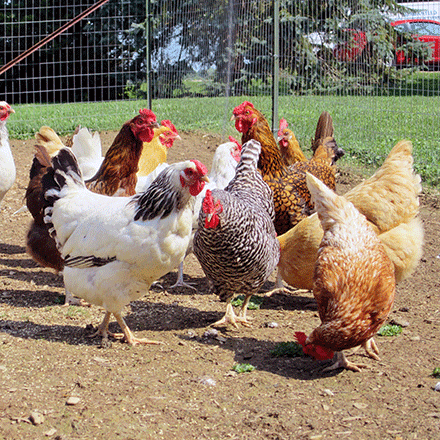
We've got the chickens under control again. They aren't destroying the garden too. A repeat of losing 3/4 of the flock shouldn't happen again this winter. We might even start hatching eggs and meet our own poultry needs in Spring of 2019. I've downloaded plans for a grow out pen for the butchering chickens. That's a grey infrastructure deal. That would be another step big forward. I've been in contact with local, no chemical producers of lamb, pork, and beef so that will be another check mark towards being psuedo self sufficient in a protein source since Zaycon went belly up this year.
We'll be planting wheat, barley, and oats again in the orchard next spring. We'll replace the area with fruit trees and bushes as we go. It will go a long way in cutting our feed bills for our small livestock. I'm finally done with the research portion of us acquiring some pygora goats. We'll be starting on the goat pen in mid 2019. Whether we actually get the goats in 2019 or 2020 is still up for discussion. It's a fairly Green/Grey infrastructure expense of between $500-$1500. We'll have to see where we stand before deciding.
In 2020, we'll be clearing and terracing another 1/4 of an acre earmarked for two tiny houses and a grain/straw/hay area. Hopefully, we can entice a couple of folks to come onboard with us in our cockeyed community adventure. We could honestly use the manpower. We ain't getting any younger. Plus, the added income couldn't hurt either. We are still leaning towards widows and single females in our vision quest.
It seems like everything we want to do is costing us $1500 or more. That takes some planning. Not to mention my daughter's wedding in Tuscon next summer. It only takes money, right? But that which does not grow- dies.
Thirty
cases of pint canning jars that I went to North Carolina to get a
couple of weeks ago are now washed, put back in their boxes, and stacked
into their respective spots in the storage building.
Plus,
the food grade three-gallon buckets are washed, and filled with the
GMO-free flour, wheat, and raw sugar I bought at the Amish store also from my trip to
North Carolina. My van was packed coming home, but not as packed as
last time when I brought home sixty cases of jars, but I did buy more
flour and sugar this trip.
All thanks to one of our Cockeyed Homestead YouTube subscribers. Who lives near the Amish store. She opened her house to me and let me stay. Thank you, Ellen! Another subscriber I tried to meet on this trip had a family emergency. Maybe next year, Marie. I'd really love to see your homestead operation.
In
a year, we used 40 lbs of sugar. It was used in baking, canning, and
wine making. So I bought ten extra pounds to make even more wine with. At $0.88 a pound, I
thought it was a bargain.
By picking up my Clear-jel also, I have all I
need except for the produce to make my cream of chicken and mushroom
soups for the coming year with plenty of Clear-jel for my pie fillings
too. The base ingredient (thickener) for all my canned goodies that are yummy in our tummies. I'm still hitting the reduced price section for mushrooms and dehydrating them. If there is a lot of them, six# or more, I'll can my cream of mushroom soup. The chickens for the cream of chicken soup are awaiting slaughter. They'll be pressure cooked to make them tender. Now, all I have to do is wait until my onions and celery are ready to harvest for both.
I
still may have to buy more sugar for the wine making though. It all
depends on our Muscadine and Catawba grape harvests. I plan on setting
aside a few pounds for fresh eating and jellies. I might even try
canning some for winter munching. The rest will go into the 5-gallon
recycled water jugs for wine. It might make an interesting flavored
vinegar if the wine turns too. We've been saving Mel's wine empty wine
bottles for a year now to put the wine in once it's finished. I may play
with blueberry, apple, blackberry, and raspberry flavored wines also. It all depends on the harvest. I
missed the dandelion harvest due to rains and busyness of planting the
garden this spring. There's always next year.
In the store, I went up and down each aisle as usual. But as I expected, there wasn't much "new" or exciting to pick up. Not that I was shopping for anything else. So now I've checked off three items that I'd need for a year of baking, cooking, and canning.
No trip would be complete without a trip to their version of thrift stores. I love a good bargain, don't you? I told Ellen that I was looking for another fermenting crock. A good size crockpot bottom is what I normally use. While I had two, and bountiful harvest would overwhelm them. We found one without a lid ($3). I put in my basket and traveled down the aisle. I saw another crock on the top shelf. I thought it was a cookie jar. It was too heavy for me to lift one handed so I pulled off the lid preparing to lift it by the rim. Ellen came to my rescue and lowered it down for me to get a better look. It was a complete German fermenting pot. The same one pictured. Brand new it sell on Amazon for $59 plus shipping. My price at the second hand shop...$10.
Now, if I just had a solution for our milk consumption, we'd be set. Yes, I know we need goats. A cow, even a miniature one, is an impossibility. I've researched it. We are still not set up for housing and caring for goats. I refuse to buy any animal unless we are knowledgeable about the animal, had everything in place for the animal, and an outlet for any extra production (like milk, cheese, butter) from that animal. It's just a smart way to do it.
I'm still a firm believer that an animal pay it's own way on our homestead. Either in production we can use to replace a grocery item, or for straight cash sales in babies, or products like our rabbits and chicken do. On such a small homestead with a limited resources, this is an important consideration. The fact that we'd need multiples because they are herd animals is also part of this consideration. They will also be a huge outlay of initial cash for them and creating a habitat for them. It isn't in the budget for this year even though it was on my 5-year plan for this year. I'm running at least a year behind schedule with Mel being out of work.
I'm also still researching mini angora goats (Nygora or Pygora). They would give us triple bang for our dollars in meat/for sale, milk and fiber. So long as I'm in research mode, there won't be a purchase.